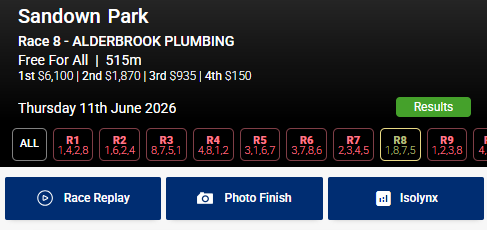
For a lot of people it’s a bunch a numbers that are hard to understand and that’s a fair take. For some insight on how to take advantage of it, here are some of the key metrics I personally take into consideration when doing form.
How do I use it?
For me it’s a must have companion when doing form on our metropolitan meetings. It often tells us exactly what we see, but there are plenty of nuggets that are extremely useful. Especially when greyhounds are stepping up or down in grade. I always have it open on my screen with The Rocket Scientist form guide printed in front of me.
Personally, I find the most useful metrics are (for ‘500’ metre racing at our city tracks):
20m time
It’s essentially how well they began. Visually (watching a replay) this is a hard one to judge depending on the quality of the field, but the number tells us plenty. Beginning moderately in a Free-For-All could have you clearly leading in a lesser quality of race. A fast time is generally 2.10-2.15, with slow being 2.20 onwards.
20-50m time
Once you’ve done replays and worked out what direction greyhounds are likely to jump in and their habits, this one becomes important. If a moderate beginner is going to get room and its 20-50m time is usually hot – take notice, they’re going to go forward. The elite run 1.73-1.74, normal is about 1.80 and anything beyond is slow.
Back split and run home time
In traditional results, they’re metrics we only get for the greyhound who leads to the back split and it’s guess work for the rest of the field. Isolynx solves that problem. We get a back split and run home for every runner and for those who have been watching city racing for a while you know what’s strong and what isn’t at each track.
My take on the traditional comparisons…
For the first split a 5.10 at Sandown equates to a 5.13 at The Meadows. With the back split, there’s basically a second between them – an 18.80 at Sandown would be 17.80 at The Meadows.
As for run home times, a little tougher to judge…
Really strong – around 10.40 at Sandown, 11.85 at The Meadows
Neutral – around 10.70 at Sandown, 12.25 The Meadows
Things like last 100m makes this easier, but we see marginally faster last 100m times at Sandown due to the track having a slight decline in the home straight compared to The Meadows. Some of the quirks are listed at our Race Data page.
Last 100m time
The run home time is good but 10-12 seconds a wide range, by that I mean a dog can be going hot around the home turn but fade bad in the last 50m or so which makes the last 100m important. Breaking 6 seconds is strong, getting down to 5.80 is really strong.
Speed at 500m
This is an extension to the above, it’s a good indication how they’ll go stepping up to 600m. Those who get to this point at 62kph, there’s very little doubt they’ll handle a step up in distance from the ‘500’ to the ‘600’ and do so with ease.